The Swedish Engineer Nobody Listened To — Until Americans Started Dying by the Thousands

Every time you click that shoulder strap across your chest before backing out of the driveway, you're completing a gesture that took decades of stubbornness, political combat, and genuine tragedy to make routine. The seatbelt isn't just a piece of webbing. It's the physical record of a battle between public safety and corporate pride — and for a long time, corporate pride was winning.
A Simple Idea from an Airplane Engineer
Nils Bohlin didn't start his career building cars. He spent years designing ejector seats for Saab's military aircraft division, where the engineering challenge was brutally simple: keep a human body intact under extreme force. When Volvo poached him in 1958 to work on vehicle safety, he brought that same mindset to the automobile.
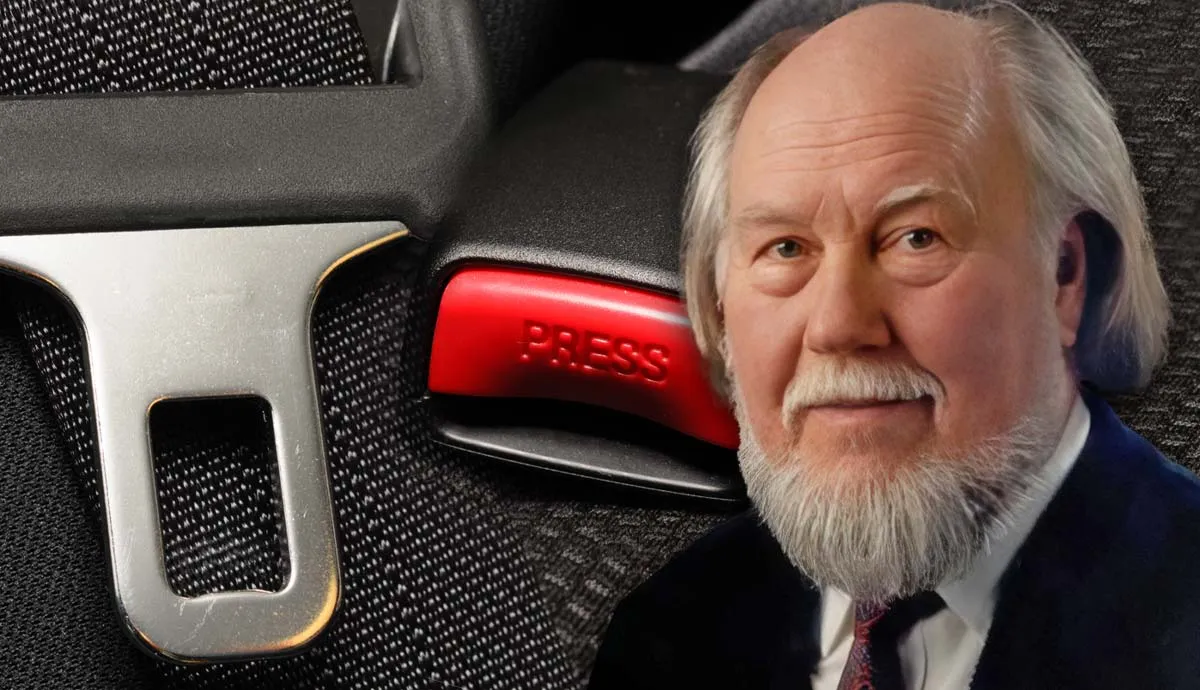 Photo: Nils Bohlin, via cdn.thecollector.com
The two-point lap belt already existed, but Bohlin thought it was half a solution at best. In a collision, a lap belt could let your upper body pitch violently forward, trading a crash injury for a different kind of crash injury. His answer was a continuous loop of webbing anchored at three points — one across the lap, one diagonally across the chest — that distributed impact force across the strongest parts of the human skeleton rather than concentrating it in one place.
Volvo introduced the three-point belt as standard equipment in 1959. Then, in a move that remains remarkable even by today's standards, the company made the patent freely available to every other automaker on earth. Volvo's reasoning was straightforward: this wasn't a competitive advantage they wanted to hoard. It was a safety feature the whole industry should adopt immediately.
American car manufacturers looked at the offer and largely said thanks, but no thanks.
Detroit's Long Resistance
The U.S. auto industry in the late 1950s was operating on a specific philosophy: cars were sold on power, style, and aspiration. The implied message in every showroom ad was freedom — the open road, the wind, the sense that nothing could touch you. Seatbelts complicated that image. Worse, from the manufacturers' perspective, they implied that the product was dangerous.
For years, Detroit argued that safety features would actually hurt sales by reminding consumers that driving could kill them. This wasn't a fringe position. It was mainstream industry strategy, repeated in boardrooms and lobbied aggressively in Washington. Some executives went further, suggesting that crashes were caused by reckless drivers rather than inadequate vehicles — a framing that conveniently shifted all moral responsibility away from the people building the cars.
Meanwhile, highway deaths in America were climbing toward 50,000 per year. The carnage was so consistent it had become background noise.
One Book That Changed Everything
In 1965, a young consumer advocate named Ralph Nader published Unsafe at Any Speed, a detailed dissection of how American automakers had systematically prioritized styling over structural integrity. The book focused heavily on the Chevrolet Corvair but its argument extended across the industry: these companies knew their vehicles were dangerous, and they had chosen profit over the people buying them.
 Photo: Chevrolet Corvair, via bringatrailer.com
 Photo: Ralph Nader, via cdn.britannica.com
The book was explosive. General Motors responded by hiring private investigators to dig up dirt on Nader — a decision that backfired spectacularly when it became public and transformed Nader from a gadfly author into a national hero. Congress hauled GM's president into a hearing room to apologize. The optics were catastrophic for an industry that had spent years insisting it had consumers' best interests at heart.
The political momentum shifted almost overnight. In 1966, Congress passed the National Traffic and Motor Vehicle Safety Act, giving the federal government authority to set mandatory safety standards for cars sold in the United States. The following year, seatbelts became legally required equipment in new American vehicles.
Mandatory Equipment Isn't the Same as Mandatory Use
Here's where the story gets a second twist. Having a seatbelt in the car and actually wearing it turned out to be two entirely different fights.
For nearly two more decades, Americans treated seatbelts as optional accessories. Surveys from the early 1980s found that fewer than 15 percent of drivers buckled up regularly. The belts were there. People just didn't use them.
New York became the first state to require seatbelt use in 1984, setting off another round of political arguments about government overreach and personal freedom. State by state, laws trickled into place through the late 1980s and 1990s, typically with fierce opposition framing every mandate as an attack on individual liberty.
The "Click It or Ticket" federal campaign launched in 2002 finally moved the needle significantly, using high-visibility enforcement to push compliance rates past 70 percent nationally. Today that number sits above 90 percent — one of the highest in the developed world, though still behind countries like Germany and Australia.
The Argument That Never Really Ended
What makes the seatbelt's history worth revisiting isn't just the engineering backstory. It's the template. The pattern of a proven safety intervention being resisted by industry, then reluctantly mandated by government, then contested by a segment of the public as an infringement on personal choice — that exact sequence has played out with motorcycle helmets, car seat requirements for children, and airbag standards.
Nils Bohlin died in 2002. By that point, researchers estimated that the three-point belt he designed had saved over a million lives. Volvo had given the patent away for free. The American auto industry had fought the adoption of that gift for the better part of a decade.
Every time you hear a click before you pull out of a parking lot, you're hearing the end of a very long argument — one that took a Swedish engineer, a crusading author, a congressional hearing, and about forty years to resolve.