How a Connecticut Pie Tin Became the Most Thrown Object in American History
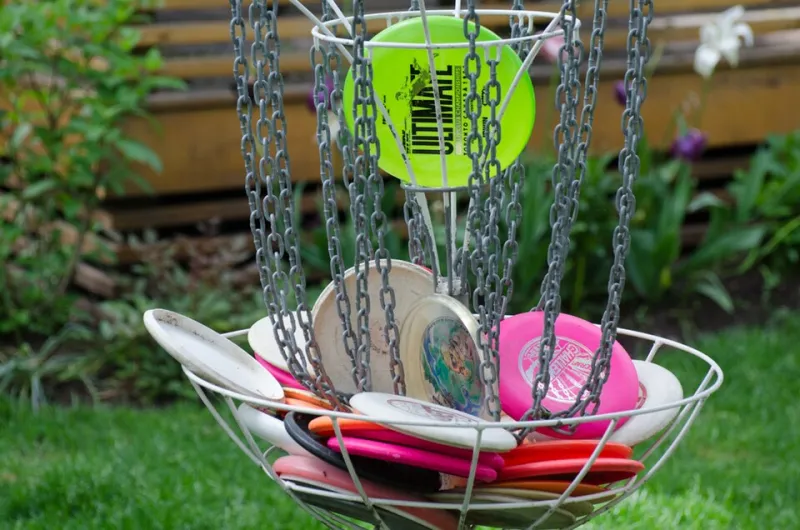
Photo: Jason Baker, CC BY 2.0, via Wikimedia Commons
Every summer, someone drags a Frisbee out of a garage, tosses it across a lawn, and thinks absolutely nothing of it. It's just one of those things — as American as a backyard barbecue or a cooler full of cheap beer. But the Frisbee didn't start as a toy. It started as a pie tin. Then it became a wartime distraction. Then the military got interested for entirely the wrong reasons. Then a couple of guys in California decided to sell it to kids.
The whole arc of it is almost too strange to believe.
Yale Students Were Doing This Before Anyone Called It Fun
The Frisbie Pie Company operated out of Bridgeport, Connecticut, and by the early 1900s, its metal tins were everywhere across New England — stacked in kitchens, tossed in trash heaps, and apparently, flung across the lawns of Yale University. Students discovered that the empty tins flew in a satisfying, stable arc when you sent them spinning off your fingertips. They'd shout "Frisbie!" as a heads-up to anyone nearby, which was both a warning and, in the way of college students everywhere, a joke about the brand name stamped on the bottom.
 Photo: Yale University, via visitorcenter.yale.edu
This wasn't an organized activity. Nobody was keeping score. It was just bored young men throwing garbage at each other — which, as it turns out, is exactly how a lot of great American traditions get started.
The tin-tossing habit spread slowly through campus culture for decades, mostly unnoticed by the wider world. Then World War II happened, and things got complicated.
The Military's Brief, Embarrassing Interest in Flying Discs
During the war years, the U.S. military was throwing money at almost anything that might give American forces an edge. Flying disc concepts attracted genuine attention from certain corners of the defense establishment — not because of pie tins, but because the aerodynamic stability of a spinning disc seemed like it might have weapons applications. Reconnaissance equipment, maybe. Delivery mechanisms for small payloads. The specifics got classified quickly and stayed that way.
None of it panned out. The disc concepts that made it to prototype stage were either impractical, underpowered, or simply outperformed by existing technology. The military moved on. The flying disc went back to being a novelty.
But the aerodynamic research didn't disappear. It percolated. And when two California entrepreneurs started looking for their next product in the mid-1950s, some of that thinking was quietly available in the background.
Wham-O Takes a Flier on Flying
Rich Knerr and Arthur "Spud" Melin founded Wham-O in 1948, originally selling slingshots out of a garage in San Gabriel, California. They had a talent for spotting weird ideas and turning them into things people would pay for. In 1957, they heard about a flying disc prototype made from plastic — developed by a man named Walter Frederick Morrison, who had been tinkering with disc designs since the late 1940s, partly inspired by watching people throw pie tins at the beach.
Morrison called his design the Pluto Platter, leaning into the UFO craze that had gripped America in the postwar years. Knerr and Melin bought the rights, renamed it the Frisbee (deliberately misspelling the pie company's name to avoid trademark trouble), and started manufacturing it in early 1957.
The initial sales were modest. So Wham-O did something clever: they sent representatives to college campuses to demonstrate the disc in person, handing them out and teaching students how to throw them properly. It was one of the earliest examples of what marketing people now call experiential promotion — getting the product into people's hands in a setting where they'd naturally want to use it.
It worked spectacularly.
From Campus Craze to Backyard Institution
By the early 1960s, Frisbee sales were climbing fast. Wham-O refined the design repeatedly, adjusting the weight, the lip, and the aerodynamic profile to make the disc more controllable and more satisfying to throw. They introduced different versions for different uses — lighter discs for casual tossing, heavier ones for distance.
The sport of Ultimate Frisbee was invented by high school students in Maplewood, New Jersey, in 1968, adding a competitive dimension that gave the disc a whole new context. Disc golf followed in the 1970s. By the time the Frisbee hit its commercial peak in the late 1970s, Wham-O was selling over 100 million of them a year.
 Photo: Maplewood, New Jersey, via www.harringtonmovers.com
The Frisbie Pie Company, for its part, had closed in 1958 — just one year after its unwitting namesake hit the market.
The Accidental Genius of Throwing Garbage
What's striking about the Frisbee's history isn't just the strange route it took to get here. It's what the story reveals about how American leisure culture actually develops. The military's interest in flying discs produced nothing useful. The pie company's tins became toys by accident. The product that eventually conquered backyards across the country was essentially a refined version of a college prank.
America has a long tradition of turning discarded ideas, failed experiments, and forgotten government projects into something people genuinely love. The Frisbee is just one of the cleaner examples — a piece of Connecticut baking history that somehow ended up in the hands of every kid who ever spent a summer afternoon doing absolutely nothing in particular.
Which is, when you think about it, exactly where it belongs.