The Tiny Word That Started as a Threat and Became the Foundation of American Manners
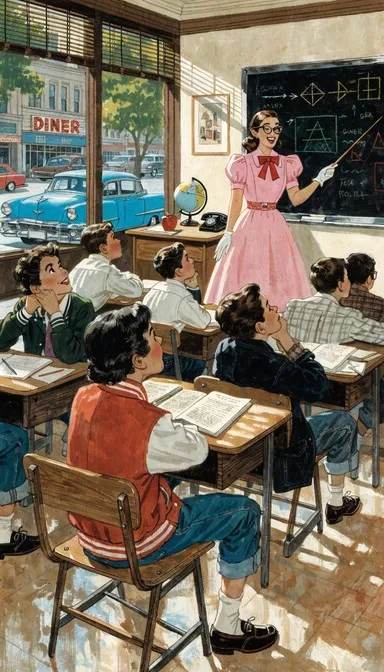
Photo: vintage American etiquette manners classroom 1950s children, via images.stockcake.com
You say it dozens of times a day. You teach it to children before they can tie their shoes. It's printed on signs in kindergarten classrooms and muttered reflexively at coffee shop counters across the country. But the word "please" — that small, seemingly innocent syllable at the end of a polite request — didn't start out as a courtesy. It started out as something closer to a challenge.
And the story of how it went from quiet insolence to cornerstone of American manners is a lot stranger than you'd expect.
It Wasn't Always About Being Nice
The word "please" is a contraction — a linguistic shortcut that English speakers have been using so long, almost nobody remembers what it's short for. The full phrase was if it pleases you, or in older forms, if it please thee. And when you hear it in its complete form, the meaning shifts considerably.
Tell someone "Give me the salt" and you're issuing a command. Tell someone "Give me the salt, if it pleases you" and you're doing something subtler — you're technically making the entire request conditional on their approval. You're suggesting, however gently, that they have the power to refuse.
In medieval England, where rigid social hierarchy dictated almost every interaction, that was a radical little maneuver. Servants and tradespeople began using the phrase when addressing those above them in the social order — not because they were feeling generous, but because it offered a thin layer of protection. If a lord or merchant became irritated by a request, the speaker could argue they'd left the decision entirely in the other party's hands. It was deference as a defense mechanism.
Over generations, the phrase collapsed into a single word and the original meaning blurred. But the underlying logic — embedding a request inside an acknowledgment of someone else's power — stuck around in the culture long after people forgot they were doing it.
How America Inherited the Word and Then Rewired It
When English-speaking settlers brought the language to the American colonies, they brought its politeness rituals with them. But colonial America was doing something unusual with social hierarchy: dismantling it, at least in theory. The democratic experiment meant that the old European logic — where you deferred to people above you in rank — didn't map cleanly onto a society that kept insisting everyone was equal.
So "please" had to find a new job.
Through the 18th and 19th centuries, as American commerce expanded and strangers increasingly had to negotiate with each other across class and regional lines, the word became less about hierarchy and more about transaction. You said "please" not because the other person outranked you, but because you were acknowledging that cooperation was mutual. It was the verbal equivalent of extending a hand.
Etiquette manuals of the mid-1800s started treating politeness as a business skill rather than a social obligation. Books like The Habits of Good Society, which circulated widely in American cities, framed courteous language as a competitive advantage — a way to build the kind of trust that made commerce run smoothly. "Please" wasn't just nice. It was useful.
The Immigrant Angle Nobody Talks About
Here's where the story takes a turn that most histories of the English language skip right over.
In the late 19th and early 20th centuries, millions of immigrants arrived in American cities speaking little or no English. For communities navigating a society that was often hostile to their presence — Italian, Jewish, Polish, Chinese, and dozens of other immigrant groups — learning the mechanics of American politeness wasn't a social nicety. It was a survival strategy.
Language schools and settlement houses, particularly in cities like New York, Chicago, and Boston, taught new arrivals that certain English words carried disproportionate social weight. "Please" and "thank you" were at the top of every list. Instructors emphasized that these words could disarm suspicion, smooth over misunderstandings, and signal — even to people who didn't share your language — that you were operating in good faith.
What's fascinating is that many of these communities applied the word more deliberately and more consistently than native English speakers did. In some immigrant neighborhoods, excessive politeness became a kind of group practice — a way of collectively managing the hostility of the outside world by making every interaction feel low-threat and cooperative.
Historians of American immigration have documented how this behavior gradually influenced the broader culture around it. Shopkeepers who dealt primarily with immigrant customers began mirroring the language back. The habit spread. American service culture — which by the mid-20th century had become famous worldwide for its emphasis on friendliness and accommodation — was shaped, in part, by communities who had learned that politeness was the cheapest form of protection available to them.
The Word That Outlasted Its Own Meaning
Today, "please" functions almost entirely on autopilot. Most people who say it aren't consciously acknowledging anyone's power or trying to manage a social dynamic. It's just what you say.
But that automaticity is itself a kind of historical artifact. The word became reflexive because generations of Americans — from colonial merchants to Ellis Island arrivals to 1950s customer service trainers — deliberately embedded it into daily life for reasons that had nothing to do with simple kindness.
It started as a rhetorical hedge. It became a business tool. It was weaponized as a shield by people who had few other options. And somewhere in that long, complicated journey, it turned into the thing we now teach children first: proof that you were raised right.
Not bad for a word that used to be an insult in disguise.