Why You Shake Hands the Way You Do — And Who Decided That Was the Right Way
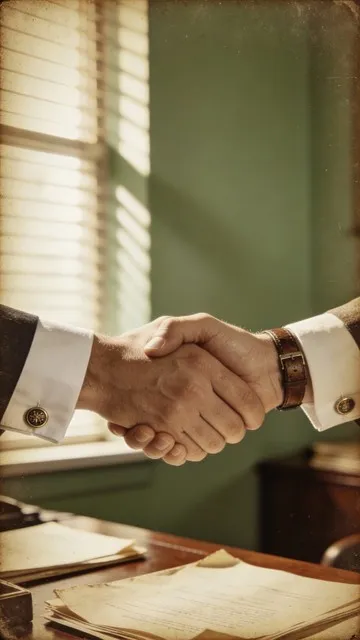
Photo: vintage 1920s businessmen handshake formal meeting sepia photograph, via images.stockcake.com
Next time you shake someone's hand, pay attention to what you're actually doing. Firm grip — not crushing, not limp. Two or three pumps, no more. Eye contact held throughout. A slight forward lean, maybe. Release clean, no lingering.
You almost certainly follow these unwritten rules without thinking about them. But here's the thing: those rules aren't ancient. They aren't instinctive. They were written down, debated, revised, and then deliberately taught to generations of American businesspeople starting in the late 1800s — and the process that standardized them is one of the stranger chapters in the history of American commerce.
The Handshake Before It Got Standardized
Handshakes themselves are genuinely old. Historians have traced the gesture back to ancient Greece and Mesopotamia, where clasping hands served as a visible, physical signal that neither party was holding a weapon. The gesture showed up in medieval European diplomacy and eventually crossed the Atlantic with English settlers.
But for most of American history, there was no single "correct" handshake. Regional variations were dramatic. In parts of the rural South, a handshake could involve a full two-handed clasp and extended eye contact that would feel intrusive in Boston. In certain Northern commercial cities, a quick, light touch was considered appropriately businesslike. Quaker communities — who had already helped normalize the handshake as an egalitarian alternative to class-coded bowing — had their own conventions around duration and grip.
For most of the 18th and early 19th centuries, this patchwork of regional customs worked fine. People mostly did business with people they already knew, in communities where the local conventions were understood.
Then the railroads happened.
The Problem With Trusting a Stranger
The rapid expansion of American commerce in the mid-to-late 1800s created a new kind of social problem. Businesspeople were suddenly meeting strangers from other cities, other regions, other backgrounds — people who dressed differently, spoke differently, and carried themselves differently. The old community-based signals of trustworthiness didn't translate across distance.
This is where things get interesting, and where a forgotten corner of the confectionery trade enters the picture.
In the 1870s and 1880s, traveling candy and dry goods salesmen were among the most mobile commercial figures in America. They moved between cities constantly, meeting new buyers and merchants at every stop, and they had almost no time to build the kind of slow-burn trust that traditional commerce relied on. Their livelihood depended on making a convincing impression within minutes.
Some of these salesmen began keeping informal notes — essentially proto-training manuals — on which physical behaviors seemed to generate the fastest trust responses in strangers. Grip firmness came up repeatedly. So did eye contact. So did the question of how long to hold the shake before releasing. A confectioner's sales representative based out of Philadelphia named Elias Corwin — a figure who appears in at least two trade publications of the era but who never became famous — reportedly circulated a written guide among colleagues describing a specific handshake protocol he claimed had measurably improved his closing rate.
Corwin's guide was informal and unpublished in any official sense. But the ideas in it were circulating in commercial culture at exactly the moment that American business education was becoming formalized.
The Classroom That Turned a Greeting Into a Science
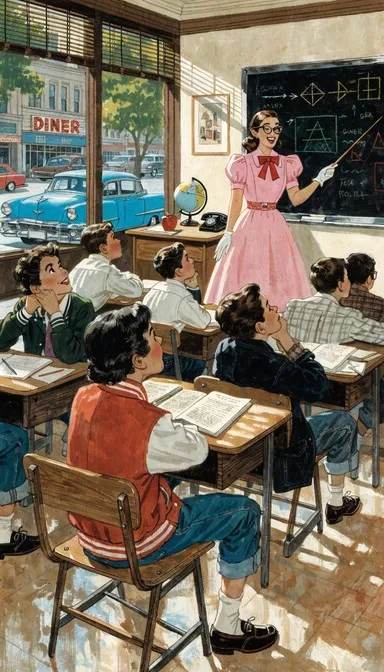
The late 19th century saw the founding of America's first dedicated business schools — the Wharton School at the University of Pennsylvania opened in 1881, and others followed quickly. These institutions were trying to do something genuinely new: turn the intuitive arts of commerce into teachable, repeatable skills.
Salesmanship courses became a significant part of the curriculum, and within those courses, the physical performance of trustworthiness got serious attention. Instructors understood that in a national commercial economy full of strangers, the handshake was doing a job that used to be done by years of community reputation. It needed to be reliable.
By the early 1900s, business school instructors in cities including Philadelphia, Chicago, and New York were teaching standardized handshake protocols with a specificity that would seem almost comical today. Students practiced on each other. Grip strength was discussed. The "pump" — the up-and-down motion — was analyzed for optimal duration. Eye contact was framed not as a social nicety but as a signal of confidence and transparency.
The underlying theory was essentially that character could be made legible in a single gesture, if that gesture was performed correctly. A firm grip meant reliability. Sustained eye contact meant you had nothing to hide. A clean release meant you weren't trying to dominate the interaction. Every element was assigned a meaning.
How the Formula Spread Beyond Business School
By the 1920s and 1930s, the standardized American handshake had migrated well beyond university classrooms. Dale Carnegie's wildly influential How to Win Friends and Influence People, published in 1936, reinforced many of the same principles for a mass audience. Self-help culture, corporate training programs, and the booming world of door-to-door sales all picked up the framework and spread it further.
What's striking is how thoroughly the regional variations got smoothed out. The two-handed Southern clasp largely retreated from formal business settings. The light Northern touch got replaced by the firm pump. A single national standard — rooted in the commercial logic of late 19th-century salesmanship — became the American handshake.
A Gesture That Carries More History Than It Looks Like
The handshake you give at a job interview, a first meeting, a business lunch — it's carrying about 150 years of deliberate social engineering. Someone sat down and figured out how to make trust visible in under five seconds, and the formula they arrived at is still running.
It started as a practical solution to a commercial problem. It got refined in classrooms. It was packaged and sold in self-help books. And now it's so deeply embedded in American social behavior that it feels completely natural.
Which is, when you think about it, exactly what the people who designed it were going for.