Stop for a moment and count how many times you've said 'OK' today. In texts, in meetings, out loud when someone asks if you want fries with that. It's so automatic that it barely registers as a word anymore — it's more like a verbal reflex, a universal signal that means everything from yes to I heard you to please stop talking.
Language experts have called it the most widely understood word in human history. It crosses borders, cultures, and languages in a way that almost nothing else does. And yet the story of how it got here is genuinely bizarre — a chain of events involving bad spelling, political spin, and a president most Americans couldn't pick out of a lineup.
It Started as a Joke That Wasn't That Funny
The year was 1839. Boston was in the middle of a peculiar cultural moment: abbreviations were trendy. Newspapers — the social media of the era — had developed a habit of using shortened forms of common phrases, sometimes intentionally misspelled for comic effect. It was the kind of inside-joke humor that would feel right at home in an internet comment section today.
On March 23, 1839, the Boston Morning Post published a piece that used the abbreviation 'o.k.' as a jokey shorthand for 'oll korrect' — a deliberately mangled spelling of 'all correct.' It wasn't the first abbreviation of this type, and it wasn't even the cleverest. Abbreviations like 'O.W.' (oll wright) and 'G.T.D.H.D.' (give the devil his due) were floating around at the same time.
Most of those faded away almost immediately. 'OK' should have done the same.
Then a Presidential Campaign Changed Everything
Here's where the story takes a turn nobody could have predicted. In 1840, President Martin Van Buren was running for re-election. Van Buren was from Kinderhook, a small town in New York's Hudson Valley, which had earned him the nickname 'Old Kinderhook' among his supporters. His campaign clubs — essentially the political grassroots organizations of the day — began calling themselves the 'OK Clubs.'
 Photo of Kinderhook, via Wikidata/Wikimedia Commons
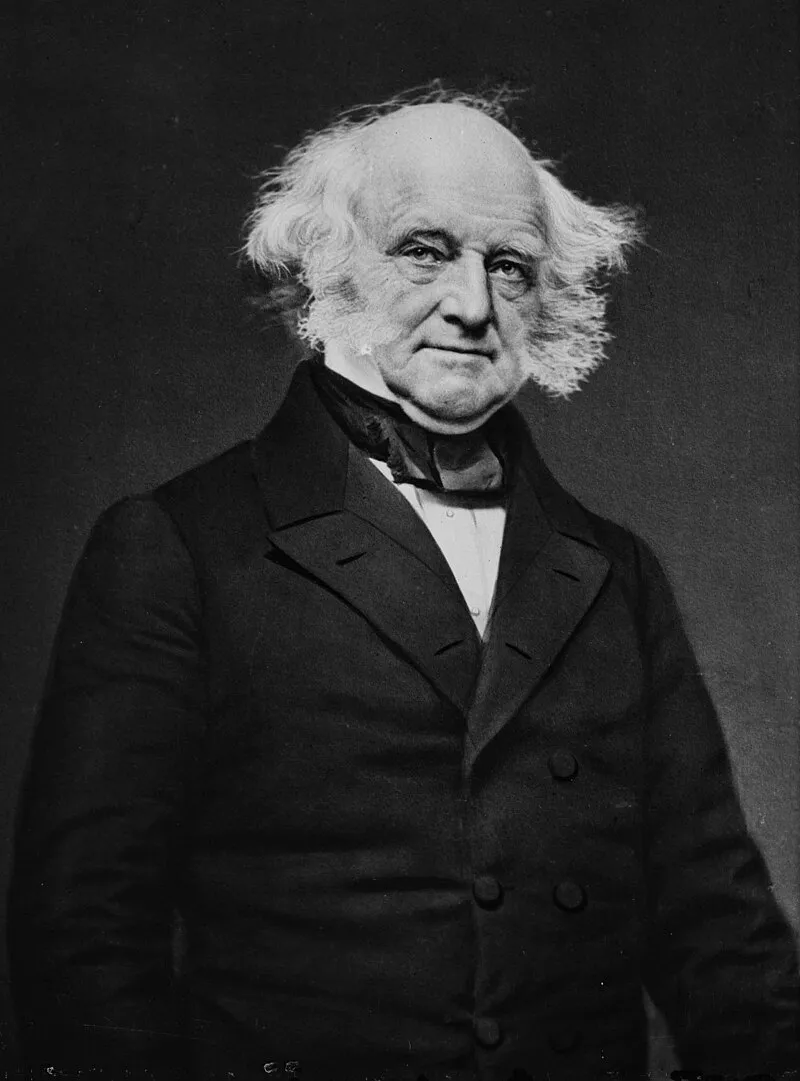 Photo of Martin Van Buren, via Wikidata/Wikimedia Commons
The timing was perfect, or rather, perfectly accidental. The abbreviation 'OK' had just entered public consciousness through the Boston newspaper joke the previous year, and suddenly it had a second meaning layered on top of it: a presidential slogan, a rallying cry, a symbol of political identity. Supporters started showing up to rallies with 'OK' banners. The phrase spread through newspapers up and down the East Coast.
Van Buren lost the election. But 'OK' survived him by about 180 years and counting.
How a Word Goes Viral Without the Internet
The spread of 'OK' in the 1840s is a fascinating case study in how information traveled in pre-telegraph, pre-railroad America. Newspapers reprinted each other's content constantly. Political slogans moved through pamphlets and public speeches. A phrase that appeared in a Boston paper could work its way to Philadelphia, then Baltimore, then Charleston within weeks.
But 'OK' had something most slang didn't: flexibility. It could confirm agreement. It could signal that something was acceptable. It could be a question or an answer. That adaptability is what linguist Allan Metcalf, who literally wrote the book on the subject (OK: The Improbable Story of America's Greatest Word), argues is the real key to its survival. It filled a gap in the language that speakers didn't even know existed until it showed up.
By the mid-1800s, it had moved beyond politics and newspapers into everyday speech. Telegraph operators adopted it as a quick confirmation signal. Railroad workers used it as a safety clearance code. Each new industry that picked it up gave it another layer of legitimacy.
OK Goes Global
The twentieth century turned 'OK' into something that transcended English entirely. American soldiers carried it into both World Wars, seeding it across Europe and the Pacific. Hollywood exported it to every country that watched American films. And then the digital age arrived and finished the job completely.
Today, 'OK' appears in virtually every major language without translation. It's used in Japanese, Arabic, Hindi, Portuguese, and Swahili. When researchers have tried to identify the single most universally understood word across human languages, 'OK' consistently tops the list. Some estimates suggest it's spoken or written billions of times every single day worldwide.
All of this from a deliberately misspelled newspaper joke in 1839.
The Word That Outlasted Everything
Martin Van Buren is remembered today, if at all, as a moderately obscure one-term president — the first president born as an American citizen rather than a British subject, if you want a trivia hook. His 'OK Clubs' are a footnote in a footnote.
But every time you fire off an 'OK' in a text, confirm an order, or tell someone their idea works for you, you're unknowingly echoing a Boston newspaper gag and a forgotten political campaign from almost two centuries ago.
Language is full of these buried backstories. Most of them stay buried. This one just happens to be hiding in plain sight, two letters at a time.