When Innovation Forgot the Most Important Part
Picture this: It's 1850, and you're standing in your kitchen holding a tin can of peaches. The food inside is perfectly preserved, ready to eat, and completely unreachable. Your options? Grab a hammer and chisel, hack away with a knife, or maybe try your luck with an axe.
This wasn't some frontier survival situation—this was everyday life in 19th-century America. For nearly five decades, the tin can existed without its perfect partner, the can opener, creating one of history's most frustrating examples of incomplete innovation.
The Container That Came Too Early
The story begins in 1810 when British inventor Peter Durand patented the tin can. His timing seemed perfect—Napoleon had recently offered a cash prize for better food preservation methods, and armies across Europe desperately needed portable nutrition that wouldn't spoil during long campaigns.
Durand's cans were engineering marvels for their time. Made from thick iron and coated with tin, they could preserve meat, vegetables, and fruits for months or even years. There was just one tiny problem: Durand apparently never considered how people would actually access the food inside.
The original patent instructions were almost comically unhelpful: "Cut round the top near the outer edge with a chisel and hammer." Some cans even came with printed directions suggesting buyers use a bayonet or similar sharp instrument to pierce and pry their way in.
America's Hammer-and-Chisel Era
When tin cans arrived in America during the 1820s, the opening situation became even more absurd. American manufacturers made their cans even thicker and stronger than European versions, creating what were essentially edible safes.
Families developed elaborate rituals around opening canned goods. The strongest family member would take the can outside, place it on a tree stump or anvil, and spend several minutes hammering and chiseling while everyone else waited. Some entrepreneurial Americans even offered can-opening services, charging neighbors a few cents to crack open their preserved foods.
The military faced particular challenges. Civil War soldiers sometimes resorted to shooting their cans open with rifles, or rubbing them against rocks until the metal wore thin enough to break. More than one battle was delayed because troops couldn't access their rations in time.
The Connecticut Mechanic Who Solved Everything
By 1858, the absurdity had reached a breaking point. Ezra Warner, a mechanic from Waterbury, Connecticut, finally asked the question that should have been obvious decades earlier: "Why don't we make a tool specifically designed to open these things?"
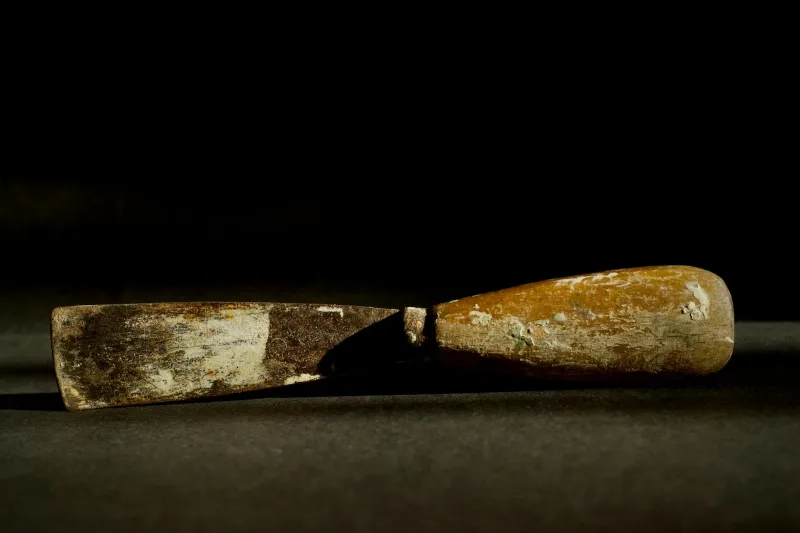
Warner's first can opener looked nothing like the sleek devices we know today. His design resembled a cross between a bayonet and a sickle, with a curved blade that pierced the can and a guard to protect the user's hand. The tool was so sharp and potentially dangerous that grocery stores kept them behind counters, and customers had to ask clerks to open their purchases on the spot.
Despite its intimidating appearance, Warner's opener was revolutionary. For the first time in nearly half a century, Americans could access canned food without risking injury or destroying their kitchen tools.
The Evolution Continues
Warner's breakthrough opened the floodgates for innovation. Within a decade, inventors across America were filing patents for improved can openers. Some featured rotating wheels, others used lever mechanisms, and a few even attempted steam-powered versions (which never caught on for obvious reasons).
The familiar rotating-wheel can opener didn't appear until 1870, and the modern electric version had to wait until the 1930s. But Warner's basic insight—that cans needed their own specialized tool—transformed American kitchens forever.
Why It Took So Long
Looking back, the 48-year gap seems impossible to explain. How did an entire generation of inventors miss such an obvious need?
Part of the answer lies in early assumptions about who would use canned goods. Durand and his contemporaries designed tin cans primarily for military use, assuming soldiers would have access to standard army tools and wouldn't mind a little extra work for preserved food.
Another factor was the Victorian era's different relationship with convenience. Many 19th-century Americans viewed struggle as character-building. The idea that food should be effortlessly accessible seemed almost morally questionable to some.
But perhaps most importantly, the gap reveals how innovation sometimes happens in incomplete bursts. Durand solved the preservation problem so completely that everyone forgot about the access problem. It took decades for someone to step back and see the bigger picture.
The Tool That Changed Everything
Today, can openers are so ubiquitous that most Americans own multiple versions without thinking about it. We have manual openers, electric models, and even smartphone apps that can identify the best technique for stubborn cans.
But Warner's 1858 breakthrough did more than just solve a kitchen problem—it established the principle that every innovation needs a complete ecosystem to succeed. The tin can wasn't truly useful until someone invented its perfect partner.
That Connecticut mechanic didn't just create a kitchen tool. He reminded America that sometimes the most important inventions are the ones that complete someone else's incomplete idea.